oneEdo: Unifying Edo State Services
From jobs to welfare, oneEdo makes access to government services clearer, easier, and fairer for everyone
Impact Highlights
Design Team: Public Digital
Partners: Edo DiDa, Edo state government
Timeline: 6-8 weeks
Location: Edo state, Nigeria
The Challenge
For millions of residents in Edo State, opportunities feel out of reach, and access to government services is complicated. Information is often hidden, confusing, or dependent on personal connections.
The Solution
oneEdo: a digital front door where people can find and access all government services in one place.
The Impact
Today, oneEdo is set to serve over 5 million residents across Edo State, giving residents a fair chance to access government services without the stress of moving from office to office, relying on hearsay, or needing inside connections.
For Success, it means finally seeing which programs exist and how to apply, instead of chasing rumors. For Dafe, it’s a trusted central source of information he can depend on and share with his community. For Ofure, it opens up training, scholarships, and job opportunities that help her earn and build a future beyond school. For Ms. Okhai, it provides access to financial and welfare support that can ease the rising costs of running her business and caring for her family. And for Aisha, it creates accessible pathways to jobs and training that include people with disabilities, so she isn’t left behind.
The Process
Discover & Inspire
The project began with a simple but difficult question: “How do residents in Edo State actually access government services today?”
At the start, we thought the problem was mostly about missing information online and outdated systems. We assumed that if residents had a digital place to find services, things would get easier. But once we began research: conducting interviews, observations, and focus groups, we learned the story was more complicated.
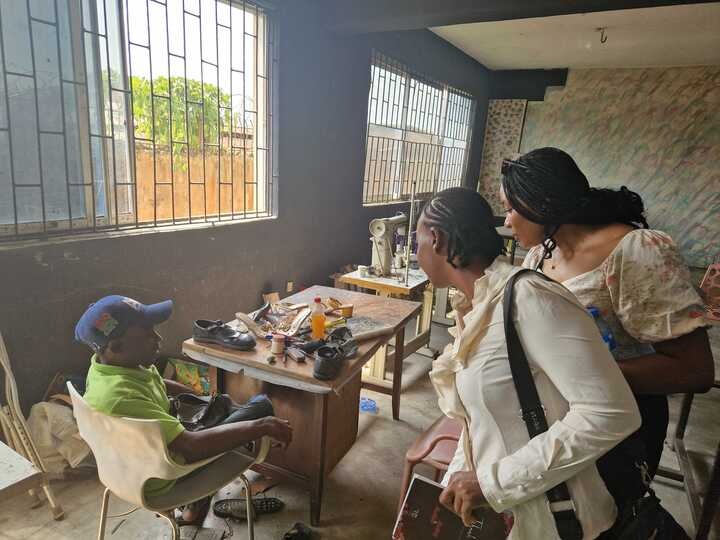
We started by listening. Over the first two weeks, we went into the field, speaking with a mix of residents: civil servants, market traders, drivers, students, and people with disabilities to hear their stories firsthand.
What people told us challenged our assumptions:
- Most citizens don’t even know these services exist.
Young people, in particular, were completely unaware of available job opportunities. Even civil servants questioned where funds like the housing scheme actually went, since they’d never seen anyone benefit. One driver put it simply: “Currently, you need connections to access relevant information.” - Even when people know about services, they can’t access them.
Trust in government was one of the biggest barriers we uncovered. People felt that unless they had the right connections, they wouldn’t stand a chance. One participant summed it up: “Being aware is one thing, accessing it is another thing.” - Most rely on in-person help.
Many residents distrusted online processes, worrying they could get scammed. “Make dem no scam me,” one participant told us. Even those who were open to digital channels often said they’d still go to the office “just to be sure.” - Information is scattered and unreliable.
We saw how residents bounced between offices and WhatsApp groups, piecing together details through friends or word-of-mouth. Services weren’t being promoted enough, and misinformation filled the gap. - Vulnerable groups feel left behind.
Residents living with disabilities spoke of feeling invisible. Many had written to the government for help and never received a response. One woman, still searching for work five years after graduation, told us plainly: “No one fit give me work.” - Cultural nuances matter.
In conversations about healthcare, people avoided speaking directly about illness. As one participant said: “We don’t pray for sickness.” These nuances reminded us that trust-building wasn’t just about technology, it required cultural sensitivity, too.
These stories revealed not just frustration, but also a cautious hope: people wanted government services to work for them, they just didn’t believe they could. The problem wasn’t just about putting services online. It was about building trust, clarity, and accessibility into every step of the experience.
We also met with the key agencies responsible for employment services: Edo Job Centre, Edo Innovates, and Edo Creative Hub. We visited their facilities, shadowed their staff, and listened to their challenges and hopes. We walked through their processes as users to find out what actually happens when someone walks through the door. These visits helped us see the system from the inside, and confirmed how fragmented the current service experience was.
This early research gave us the foundation we needed: a shared understanding of what residents were up against and what government agencies were already offering. We discovered that while residents were resourceful, relying on hearsay, WhatsApp groups, or physical visits, the absence of a trusted, central source of information left many excluded. It was clear: if oneEdo was to succeed, it had to be more than a digital interface. It had to become a single source of truth that residents could trust and share.
Post a comment